Conveyors decide outcome.
A pick-and-place maker may advertise outstanding components-per-hour figures, however those numbers suggest little when boards show up late, downstream tools blocks manufacturing, or bad transfer logic produces duplicated micro-stoppages.
That is the tough truth.
SMT Conveyor Equipments are not easy accessories. They control board activity, spacing, buffering, traceability, directing, and interaction throughout the assembly line.
Why Conveyor Design Matters
Electronics manufacturing investment continues to boost. In January 2024, SEMI forecast global semiconductor capacity would certainly exceed 30 million 200-mm-equivalent wafers monthly.
In December 2024, Reuters reported that Micron obtained a completed $6.165 billion United States subsidy sustaining major production projects in New york city and Idaho.
However need is unequal. An IPC study discovered European EMS PCBA production fell 14% in 2024.
The lesson is easy: factories require adaptable automation, not tools that works for only one product or one production forecast.
What a Constant SMT Line Actually Indicates
Continuous manufacturing does not mean every device runs without disruption. It suggests short disturbances are soaked up locally instead of quiting the entire line.
A typical arrangement is:
Loader → Printer → SPI → Barrier → Select and Position → Reflow Oven → Cooling Conveyor → AOI → Unloader
Some factories include double placement machines, board inverters, laser noting, selective soldering, finish, or automated repair transmitting.
The correct design relies on:
- Needed board result
- PCB dimensions and weight
- Item mix
- Evaluation needs
- Transition regularity
- Traceability guidelines
- Offered floor room
Buyers contrasting pick-and-place equipments ought to analyze board-entry and exit times, not only placement rate.
A rapid mounter waiting on boards is still sluggish.
Just how Does an SMT Conveyor System Work?
An SMT line conveyor gets a PCB after the downstream machine validates it prepares. Sensors find the board, belts move it, stoppers or clamps position it, and the controller releases it after processing.
The transfer series is typically:
- The upstream device reports a board is readily available.
- The downstream device confirms readiness.
- Both conveyor areas run.
- Sensing units validate the board has moved.
- The getting machine positions or procedures it.
Troubles show up when transfer heights differ, sensor reasoning is inappropriate, belts perform at dissimilar speeds, or boards exceed the evaluated size and weight range.
A dependable automatic PCB managing system need to as a result be defined making use of the complete manufacturing envelope:
- Minimum and optimal PCB dimensions
- Board density, weight, and warpage
- Part edge clearance
- Conveyor speed and instructions
- Single- or dual-lane procedure
- Guidebook or automatic size adjustment
- ESD and grounding requirements
- SMEMA or IPC-HERMES-9852 communication
- Barcode and recipe management
- Emergency-stop and reactivate actions
Quit Buying Around Small CPH
Placement speed is typically determined under regulated problems. Real manufacturing consists of transfer, placing, securing, feeder motion, examination, and persisting interruptions.
Utilize this calculation:
Needed takt time = readily available production seconds ÷ needed great boards
After that quote:
Line output = 3600 ÷ lengthiest reliable station cycle × uptime × first-pass return
Expect a manufacturing facility requires 600 good boards throughout 7 net manufacturing hours:
25,200 secs ÷ 600 = 42 seconds per board
If the placement procedure takes 38 secs and transfer includes six seconds, the real cycle is 44 seconds. The line misses out on takt prior to downtime or high quality losses are consisted of.
A much faster linking conveyor elsewhere will not resolve that traffic jam.
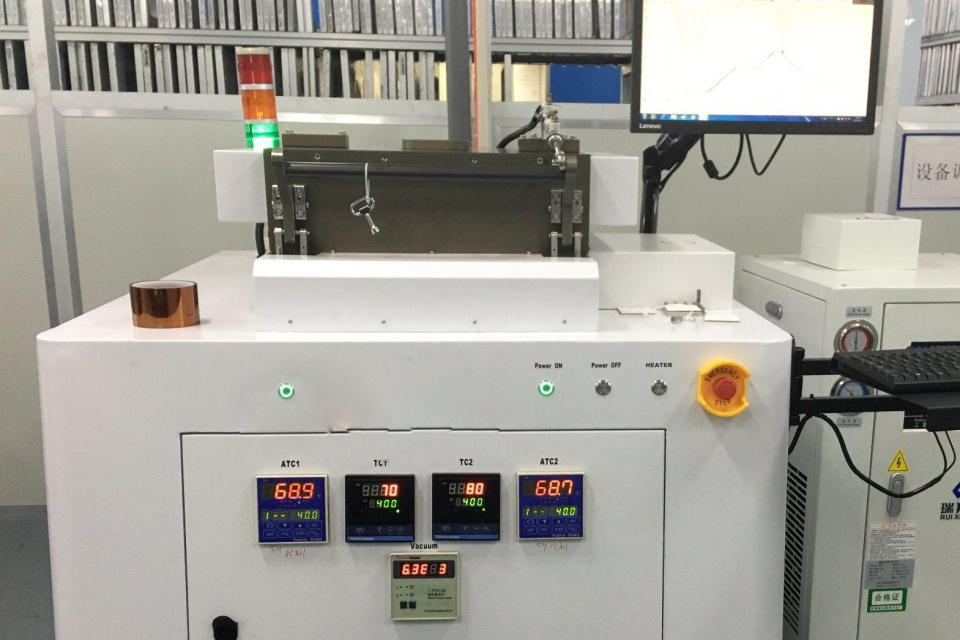
Common SMT Conveyor Modules
| Component | Main Feature | Normal Mistake |
|---|---|---|
| Linking conveyor | Transfers boards in between equipments | Getting by length without checking compatibility |
| Examination conveyor | Offers hand-operated evaluation access | Allowing assessment to block manufacturing |
| FIFO buffer | Stores boards temporarily | Utilizing barriers to conceal chronic equipment faults |
| Shuttle conveyor | Routes boards in between lanes | Neglecting software program and recipe control |
| Turn conveyor | Changes PCB direction | Falling short to evaluate warped or heavy boards |
| Cooling conveyor | Prolongs post-reflow air conditioning | Approximating cooling rather than measuring it |
| Loader/unloader | Automates magazine taking care of | Presuming all publications work |
| NG/OK unloader | Separates approved and failed boards | Losing serial-number association |
Buffering Without Concealing Problems
Barriers shield the line restriction from brief, foreseeable interruptions.
For instance, if AOI occasionally stops briefly for 90 seconds, a little FIFO buffer might maintain the positioning machine running. Yet if AOI stops for eight mins every hour, adding a large barrier just postpones the visible trouble.
It additionally enhances work-in-process and defect direct exposure.
My guideline is blunt: utilize buffers for regular variant, not as substitutes for maintenance or process adjustment.
For quantity manufacturing, conveyors and barriers should be crafted as part of a high-speed SMT production line, not purchased as unassociated makers.
SMEMA, Hermes, and Traceability
Typical SMEMA gives a basic machine-ready and board-available handshake. It remains valuable for older tools, but it lugs limited production information.
IPC-HERMES-9852 can transfer:
- Board identifiers
- PCB measurements
- Conveyor settings
- Route details
- Product information
- Maker status
Сайт IPC description of Hermes and CFX demonstrate how Hermes sustains horizontal machine interaction, while IPC-CFX links manufacturing tools with factory-level systems.
This matters since a PCB conveyor is part of the electronic manufacturing document.
If a board gets in a barrier, turn, or is eliminated manually, the system has to still understand its serial number, recipe, course, and inspection condition. Sequence-only tracking can stop working after jams, restarts, or manual treatment.
Better systems make use of barcode scanning, Data Matrix codes, RFID providers, or Hermes board identifiers.
Mechanical Information That Reason Real Failings
A lot of conveyor failures are repetitive rather than remarkable:
- A belt touches an overhanging element.
- A slim PCB slides under a stopper.
- A lengthy panel shakes throughout transfer.
- Change contamination blocks a sensing unit.
- Width change becomes misaligned.
- A hefty pallet stalls during a turn.
Prior to getting an SMT conveyor system, test the smallest, biggest, thinnest, heaviest, and a lot of warped boards anticipated throughout the equipment’s service life.
Manufacturing facility approval screening should include:
- Repeated board transfers
- Emergency quits
- Sensor failings
- Power disturbances
- Barcode failings
- Width changes
- Downstream barring
- Hand-operated board elimination
Twenty effective transfers of a very easy test panel verify very little.
Combination Ownership Issues
A mixed-brand SMT line can execute well. A single-brand line can still fall short.
The difference is normally combination possession.
One vendor or integrator must be accountable for:
- Mechanical interfaces
- Security circuits
- Equipment handshakes
- Board monitoring
- Dish administration
- Line harmonizing
- Network communication
- Approval testing
- Training and documentation
Without clear duty, each equipment distributor can claim its devices functions while the complete line continues to be unsteady.
This is why turnkey SMT line options may set you back much less general than working with numerous suppliers after installation.
What Specifies the very best SMT Conveyor System?
The best SMT conveyor system is not instantly the fastest or most automated.
For high-mix manufacturing, prioritize adaptable transmitting, automatic size adjustment, board identification, and quick dish changes.
For high-volume production, prioritize transfer repeatability, reduced upkeep time, reliable extra parts, and predictable fault recuperation.
For managed or traceability-sensitive production, focus on course enforcement, board identification, evaluation records, and controlled hand-operated treatment.
Above all, test real cycle time.
That divides a conveyor buy from a manufacturing system.
Часто задаваемые вопросы
How does an SMT conveyor system job?
An SMT conveyor system immediately moves printed circuit card in between loaders, printers, pick-and-place devices, evaluation tools, reflow ovens, barriers, and unloaders while collaborating machine-ready signals, board position, transfer speed, width settings, safety and security interlocks, and, in advanced lines, item identification and routing information.
Sensors validate board area, while belts, stoppers, clamps, and controllers manage physical activity.
What is the very best SMT conveyor system?
The best SMT conveyor system is one matched to the real PCB dimensions, weight, takt time, item mix, traceability demands, interaction protocol, maintenance ability, and factory layout as opposed to one selected only by cost, maximum rate, or manufacturer claims.
Real-board screening and reputable fault recovery matter more than brochure specs.
Can a PCB conveyor boost pick-and-place throughput?
A PCB conveyor can improve pick-and-place throughput by protecting against board hunger, downstream blocking, transfer hold-ups, imbalance, and unnecessary hand-operated handling, but it can not make up for bad feeder configuration, unsteady printing, slow transitions, reduced first-pass return, or a positioning cycle that currently surpasses manufacturing takt.
Measure the full board-to-board cycle prior to buying additional conveyor ability.
What is the distinction between SMEMA and IPC-HERMES-9852?
SMEMA is a basic electric handshake that communicates board accessibility and maker preparedness between neighboring SMT devices, while IPC-HERMES-9852 is a network-based interaction typical capable of moving board identifiers, measurements, routing info, conveyor settings, product information, and production status.
Legacy lines might make use of SMEMA, while newer systems progressively embrace Hermes.
Just how much buffer capacity does an SMT line require?
An SMT line requires adequate barrier capability to safeguard its restraint machine from typical short-duration disturbances, yet not a lot that the barrier increases work-in-process, delays issue feedback, consumes unneeded floor area, or hides repeating upkeep and procedure problems.
Ability ought to be calculated making use of gauged cycle times and standstill periods.
Build Around Real Board Flow
Do not start with conveyor length.
Begin with required output, PCB dimensions, gauged terminal cycles, product adjustments, assessment policies, traceability, fault recovery, and the maker that has to not be starved.
For a coordinated design covering positioning, conveyors, barriers, reflow, assessment, and interaction, contact the SMT line engineering group with your board requirements, target outcome, tools choices, and factory layout.